The 2025 quantitative research study on what it’s like to work in a Queensland independent school.
Welcome to the State of the Independent School Workforce report.
This report summarises the results of a survey research project undertaken in collaboration with Independent Schools Queensland’s (ISQ) Workforce Innovation Unit from February-May, 2025.
Designed to gather the perspectives of staff and leaders in Queensland’s diverse independent school sector about the challenges and opportunities they face in the school workforce, we set out to understand what makes their slice of the sector unique.
The State of the Independent School Workforce project forms part of our suite of research initiatives into what makes an effective and impactful school workforce. We want to understand how leaders and policymakers in the sector can use data to make smarter workforce decisions and build better school workforces.
If you’re interested in learning more about us or joining us on our mission to transform the work experience for those in education, please visit peoplebench.com or email hello@peoplebench.com.au.
Executive Summary
To do this effectively, leaders and governors require visibility of who comprises the workforce in independent schools, how work is done in schools, why the adults who comprise this sector choose to do this work in this context, and what it’s like to do the work.
The State of the Independent School Workforce project, a collaboration between Independent Schools Queensland (ISQ) and PeopleBench, is designed to address some of the historical gaps in the available information. This report presents the findings of the project at the whole-of-sample level, focusing largely on the results of a staff survey conducted in February-May, 2025, yielding 2,927 responses from 88 schools.
In this report, we summarise the perspectives of staff and leaders across the Sector and highlight the workforce strengths and risks so school leaders and governors can prioritise their investment of time, energy, and resources in the right areas.
The sector’s workforce strengths.
Organisational culture and staff engagement.
Queensland independent schools are generally positive places to be. Survey results suggest that staff deeply value the social and relational aspects of working in their school, such as creating a safe, supportive, and caring environment for staff and students alike. These aspects of working in an independent school were cited by staff as important to both their attraction and retention. Chart 1 presents the elements of our survey which yielded the most positive responses overall.
A majority of staff expressed positive sentiment toward their jobs, the workforce in their school, and culture of their school. The defining features of the organisational culture in most schools (regardless of school type or size) are typically the supportiveness of the working environment and the collaboration between staff. Employee engagement in these schools (as indicated by Net Promoter Scores) is generally strong: a good proportion of staff would recommend both working and studying at their school.
Chart 1: Most positive findings (overall averages).
How work is designed and managed.
In relation to employees’ experience of doing their work, our survey found that, staff generally know what is expected of them, can see how their work contributes to the purpose of the school, and feel as though they have the resources and support to deliver it. Staff also feel that they have input into which professional development activities they pursue, and have some scope to shape their roles to align to their skills and interests.
The sector’s workforce risks.
Independent schools are not immune from a challenging labour market, and leaders must be proactive about establishing a compelling Employee Value Proposition (EVP) in their own context, to stand the best chance of staffing their schools with the right people in the right roles, sustainably. Chart 2 presents the elements of our survey which yielded the least positive responses overall.
Workload management.
In several ways throughout our survey, staff expressed a need for additional support to bring workloads under control and mitigate the intensity of their work. Improving the management of workload was the single thing staff most frequently wanted to see changed in the future.
High workload—and especially the workload involved in administrative tasks—was also cited as the most likely reason for staff to leave their roles over the next year.
Staff expect that AI tools will be part of the solution to bringing workload under control, including to help automate administrative work, schedule work more effectively, and streamline other tasks such as marking.
Chart 2: Least positive findings (overall averages).
Considerations for decision-makers.
The diversity of schools in the sector is evident in this data and the right workforce for each school will depend on the unique needs of each school community.
In planning for the future, leaders should be deliberate about celebrating and preserving what works—leaders and staff can take pride in how they’ve built these strengths, and everyone working in a school has a part to play in maintaining them. Leaders should defend the positive aspects of their organisational culture (likely to include collaboration and relational support), while acknowledging the need for agility and proactiveness in today’s rapidly changing educational and employment landscape.
We anticipate that addressing the biggest risks identified in this report—excessive workload and staff expectations around flexibility—will involve a combination of organisational solutions (e.g. organisational structures and reporting lines; standardised processes and policies for how work is done), role solutions (e.g. distinguishing responsibilities between roles), behavioural solutions (e.g. adapting how leaders and staff work to allow for meaningful staff input into decisions that affect them and technological solutions (e.g. using AI tools to improve process efficiency).
Most of all, we anticipate that schools will need to take the rigour they currently apply to school improvement and apply it specifically to the goal of continuous workforce improvement. This will involve creating a cyclical process to organise a) the collection of evidence about workforce strengths and risks; b) planning and decision making based on these risks; c) well-disciplined implementation, translating plans and decisions into action; and d) evaluation of the impact of these actions so evidence-informed adjustments can be made.
Results of this survey show clearly that staff in the sector want more input into the decisions that affect them. Involving staff in this process of continuous workforce improvement (e.g. to validate workforce strategy or co-design workforce improvement projects or interventions) would be a meaningful way to provide this input, contributing to the continued development of Queensland’s independent schools as unique, sustainable, and rewarding places to work.
Project Background
Queensland’s independent school sector is growing. In 2023, the sector comprised 16.8% of state’s total student enrolments and 17.1% of the state’s teaching workforce (Independent Schools Queensland, 2024). Collectively, independent schools now employ more people (considering both teaching and non-teaching roles) than the Catholic sector.
In 2023, the sector comprised 16.8% of state’s total student enrolments and 17.1% of the state’s teaching workforce (Independent Schools Queensland, 2024). Collectively, independent schools now employ more people (considering both teaching and non-teaching roles) than the Catholic sector.
Despite the sector’s increasing prominence, information on the composition of the workforce at the sector level is relatively limited, especially in comparison to the public school sector. Based on previously available data, it is difficult to ascertain who is doing the work in independent schools at a sector-wide level, how this work is being done, why the adults who comprise this sector choose to do this work in this context, and what it’s like to do the work.
The State of the Independent School Workforce project, a collaboration between Independent Schools Queensland (ISQ) and PeopleBench, is designed to partly address these gaps in the national school workforce data landscape and provide independent school leaders with visibility of the sector’s workforce strengths and risks so they can prioritise their investment of time, energy, and resources in the right areas.
Findings in this report were drawn from our analysis of a comprehensive employee experience survey distributed to staff in participating schools between February and May, 2025. ISQ member schools were invited to participate voluntarily. During the sign-up period 93 schools joined the project, though not all contributed data. This report reflects employee experience survey data from 88 participating schools .
Unpacking employee experience in independent schools.
Largely, this report aims to unpack the employee experience in Queensland independent schools—the totality of an individual’s perceptions and interactions throughout their tenure with a school, from attraction, through the recruitment and onboarding processes, daily work life, professional development, reward and recognition, and offboarding (Schwartz & Hartman, 2021).
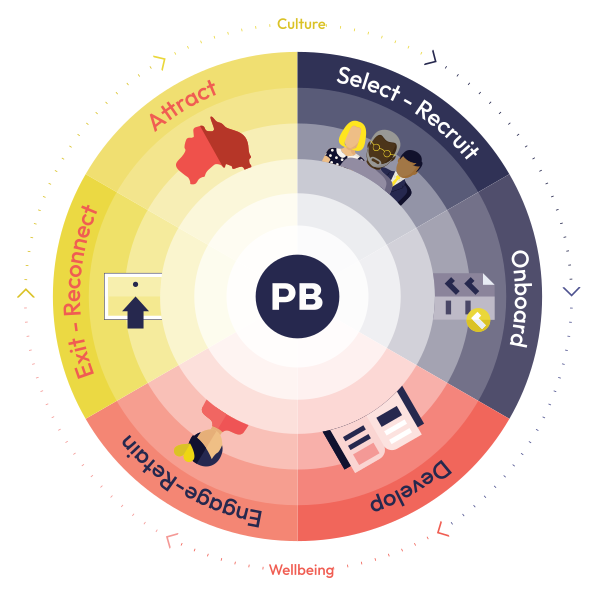
PeopleBench’s approach to understanding and measuring employee experience is based on the ‘hire-to-retire’ lifecycle model (see Figure 1). At each stage of this employee lifecycle, schools can craft a unique and rewarding experience for employees in their own context.
Attending deliberately to the employee experience in independent schools has been connected to benefits such as greater staff commitment; greater instructional quality; and greater staff capacity to innovate and respond to community needs (O’Neill & McCallum, 2022; Patel, 2023). In a tightening market for both staff and students, a deliberate and proactive approach to crafting a positive employee experience is a competitive advantage.
Figure 1: Hire-to-retire lifecycle model.
Data in this report.
This report presents two different types of data from participating schools: quantitative findings from rating scale questions and qualitative findings from open text questions. Qualitative data was coded and analysed to extract the recurring themes. Charts presenting qualitative data typically only show the top recurring themes, rather than an exhaustive list of every theme raised.
Charts in this report show either a) aggregated data for all participating schools; or b) a segmentation of the data. For conciseness, we prioritised the data segmentations that were potentially most meaningful or insightful for sector leaders for inclusion in this report.
You can think of the results in this report as indicative of the employee experience in a typical independent school in Queensland, though we acknowledge that there is considerable diversity in the independent school sector and this is reflected our sample. We urge caution in generalising findings to the whole of the sector or to any individual school. If you’re curious about how your school compares, the best approach is to collect data in your own unique context. Contact our team to discuss the PeopleBench platform where you can view your school workforce data via interactive dashboards: hello@peoplebench.com.au.
In some places, the report also references external benchmarks from PeopleBench’s datasets, which we’ve developed through our work with schools across Australia, largely in the Catholic systemic and independent school sectors.
Survey participation.
From the employee experience survey, we received 2,927 responses. As a percentage of the staff headcount in these schools, the survey response rate ranged from 6% to 100% with an average of 50%. This is a considerable sample by Education sector standards, and is broadly representative of the sector in terms of participant age, gender and role type.
The figure below shows the distribution of participating schools across the state, stretching from the News South Wales border in the south to Cape York in the north.
Figure 2: Geographic distribution of participating schools.
About PeopleBench
PeopleBench is a workforce transformation solution, built for the education sector.
In a world where school leaders are expected to wear many hats, few get the support they need to drive measurable change for the adults in their workforce. Our suite of tools and services—from data benchmarking, to workforce culture tracking, to building your bespoke workforce strategy—helps make your school a great place to work, so it can be an amazing place to learn.